
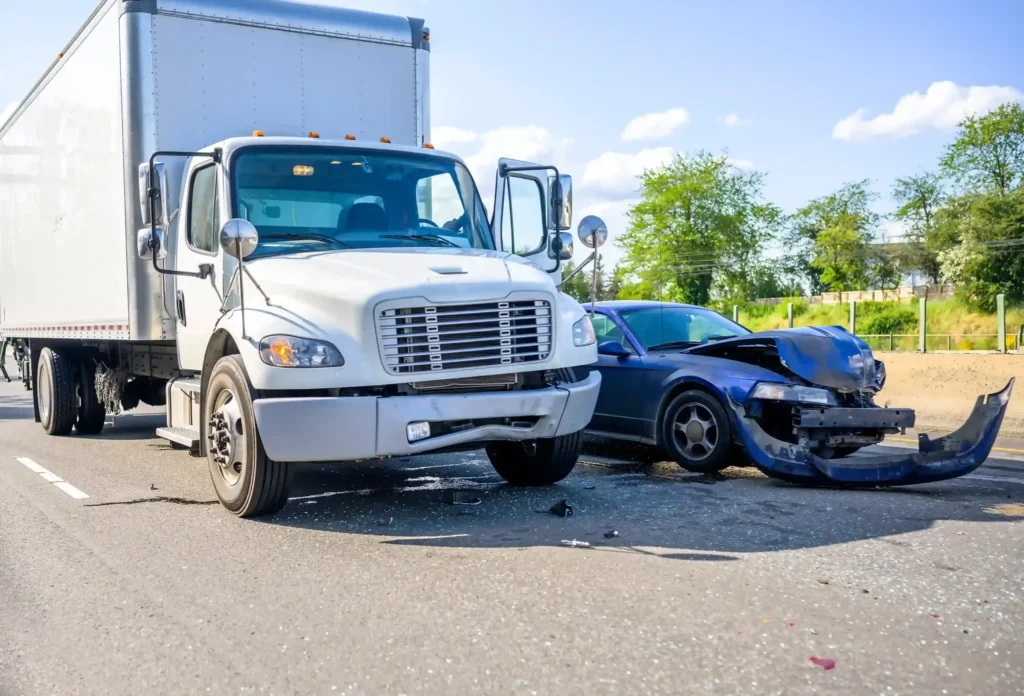
If you’ve been in a crash involving a truck or a car in Georgia, you’re likely facing questions beyond fixing your vehicle. You want answers. And one of the most pressing is whether your claim is handled appropriately. Specifically, you may wonder how truck accident claims differ from car accident claims, and what those differences mean for your recovery and legal rights.
We understand how overwhelming this process can feel. At Evans Litigation & Trial Law, LLC, we’ve represented clients on both sides of injury claims and spent over 20 years handling complex motor vehicle cases in Georgia. Our insight can help you understand your options and make informed decisions.
This article explains the key differences between a car accident claim and a truck accident claim, and why they matter when protecting your future.
Common Differences Between Truck and Car Accident Lawsuits
Although both types of claims arise from vehicle collisions, truck accident claims often involve more complexity and more severe injuries than car accident claims. Understanding these differences can help you prepare for what lies ahead and avoid common pitfalls that cost you time, money, and justice.
Below, we break down the key differences between truck and car accident cases.
Number of Liable Parties
Determining liability in a typical car accident is relatively straightforward. It usually involves just two parties: the negligent driver and the injured party (another driver, pedestrian, or cyclist).
Truck accident claims, however, are often far more complex. Multiple parties may share liability, including the:
- Truck driver,
- Trucking company,
- Truck manufacturer,
- Truck maintenance company, and
- Cargo loader.
Identifying every potentially liable party is crucial. Missing even one could reduce your ability to recover full compensation.
Severity of Injuries
The physical and emotional toll of a truck accident is often far greater than that of a car accident due to the sheer size and weight of commercial trucks. While car accidents can absolutely result in serious harm, truck collisions more often cause:
- Traumatic brain injuries,
- Spinal cord damage and paralysis,
- Crush injuries,
- Amputations,
- Severe burns, and
- Disfigurement.
These injuries frequently result in long-term disabilities, ongoing care needs, and emotional trauma. As a result, the stakes in a truck accident claim are much higher, medically and financially.
Calculation of Damages
With greater injuries come more complicated damage calculations. And more severe injuries generally involve:
- Higher medical bills due to emergency treatment, surgeries, and long-term care;
- Lost future earnings if the victim can’t return to work or must change careers;
- Pain and suffering;
- Loss of enjoyment of life; and
- Emotional distress.
More extended recovery periods also mean it may take months—or even years—before an injury victim reaches maximum medical improvement (MMI). Until that point, it’s difficult to calculate damages fully. Therefore, a truck accident claim settlement sometimes requires more thorough evaluation and strategy than a car accident claim settlement.
Gathering of Evidence
Both car and truck accident claims require strong evidence. However, the types of evidence needed and how they’re obtained can be very different. In a car accident case, you may gather:
- Police reports,
- Medical records,
- Income documents,
- Photos of the scene,
- Video surveillance footage, and
- Eyewitness statements.
For a truck accident claim, you’ll often need all that and additional evidence, including:
- Data from a black box (electronic logging device),
- Driver employment and training records,
- Truck inspection and maintenance logs,
- Hours-of-service (HOS) records, and
- Cargo manifests.
While accident reconstruction experts can play a role in both types of cases, those evaluating truck crashes must be familiar with commercial vehicle physics, braking distances, jackknifing, and other truck-specific issues.
Federal Regulations Apply to Truck Accident Claims
Truck drivers and trucking companies must follow Georgia traffic laws and federal safety regulations, which regulate:
- The number of hours a driver can operate without rest;
- Driver training and licensing;
- Drug and alcohol testing;
- Inspection and maintenance protocols; and
- Cargo weight and securement.
By contrast, car accident claims are governed solely by Georgia law and do not involve federal oversight mechanisms.
Understanding which regulations were broken and how they contributed to the crash requires in-depth legal knowledge and often, expert testimony.
What Is the Difference Between the Process for a Car Accident Settlement and a Truck Accident Claim Settlement?
While the injuries and legal complexities can vary, the settlement process for truck accident claims and car accident claims generally follows the same structure in Georgia.
Here’s how it breaks down:
- Conducting an investigation. Your attorney will gather evidence, identify liable parties, and calculate your damages.
- Sending a demand letter. Then, your attorney typically sends a demand letter to the at-fault party’s insurance company. This letter outlines the case, explains why the at-fault party is liable, and requests a specific amount in compensation based on the harm suffered.
- Negotiating. The insurance company may push back with a lower offer, dispute liability, or delay responses. Having a seasoned attorney will use their legal knowledge and evidence to negotiate with them for an outcome that aligns with your interests.
- Going to trial. In some cases, a fair agreement can be reached through settlement negotiations. If not, filing a lawsuit in court becomes necessary.
It’s important to remember that Georgia law sets a two-year deadline for filing personal injury claims, including both truck and car accident claims. Waiting too long could mean losing your right to recover anything at all.
Whether your injuries came from a car or a commercial truck, the sooner you begin building your case, the better your chances of recovering the full compensation you deserve. An experienced attorney can help guide you through the entire settlement process and protect your interests at every step.
Talk to a Personal Injury Lawyer Who Knows the Difference Between a Car Accident Claim and a Truck Accident Claim
If you’re navigating a truck or car accident claim, you need a team that understands the details, the pressure tactics used by insurers, and the long-term impact these cases can have on your life.
At Evans Litigation and Trial Law, LLC, we focus on helping injury victims rebuild. We give each client personal, strategic attention. Our seasoned legal team knows how to gather critical evidence, challenge insurance tactics, and build strong claims rooted in facts.
Don’t risk missing out on the compensation you’re entitled to. Let us help you evaluate your claim, preserve your rights, and move forward with clarity.
Contact Evans Litigation and Trial Law, LLC today for a free consultation.

Alfred L. Evans III, an Atlanta native and Hampden-Sydney College alum, is a seasoned personal injury lawyer with a unique background in insurance defense. Founding Evans Litigation and Trial Law in 2013, he specializes in wrongful death litigation, trucking litigation, and various vehicle accident cases. Recognized as a Super Lawyer and a “Rising Star” by Superlawyers, Alfred applies his in-depth knowledge of the insurance and trucking industries to maximize client recoveries.

 Loading...